Got a tax question? Our AI Tax Advisor will answer for free by email.
Bitte gib eine gültige E-Mail-Adresse ein
You invested in a cryptocurrency such as Bitcoin, Ethereum or Dash? Now you're wondering whether you have to pay tax on the purchase and what exactly you need to state in your tax return? Here you find out everything you need to know about taxes and cryptocurrencies.
Buying cryptocurrency - what you need to look out for
Although cryptocurrencies are not considered official currencies or investments in Germany, such as real estate or savings accounts, they do provide an economic benefit and fall under 'sonstige Wirtschaftsgüter' ('Other Assets') for tax purposes. Therefore, they may be taxable.
To know how much tax is due, it is important to note the purchase price and the time of purchase. So record when you bought cryptocurrency and how much you paid. Especially if you buy frequently or own different coins, it is worth creating a table of purchases and sales.
When selling, it is generally assumed that those shares you bought first, will also be the ones you sell first. This method is called FiFo - 'First in First out'.
Especially because crypto is still a relatively new tax issue for the tax authorities, it is possible that your Finanzamt (tax office) will take a closer look and demand additional information from you. So always remember to document your purchases and sales well.
Taxing crypto profits - this is how it works
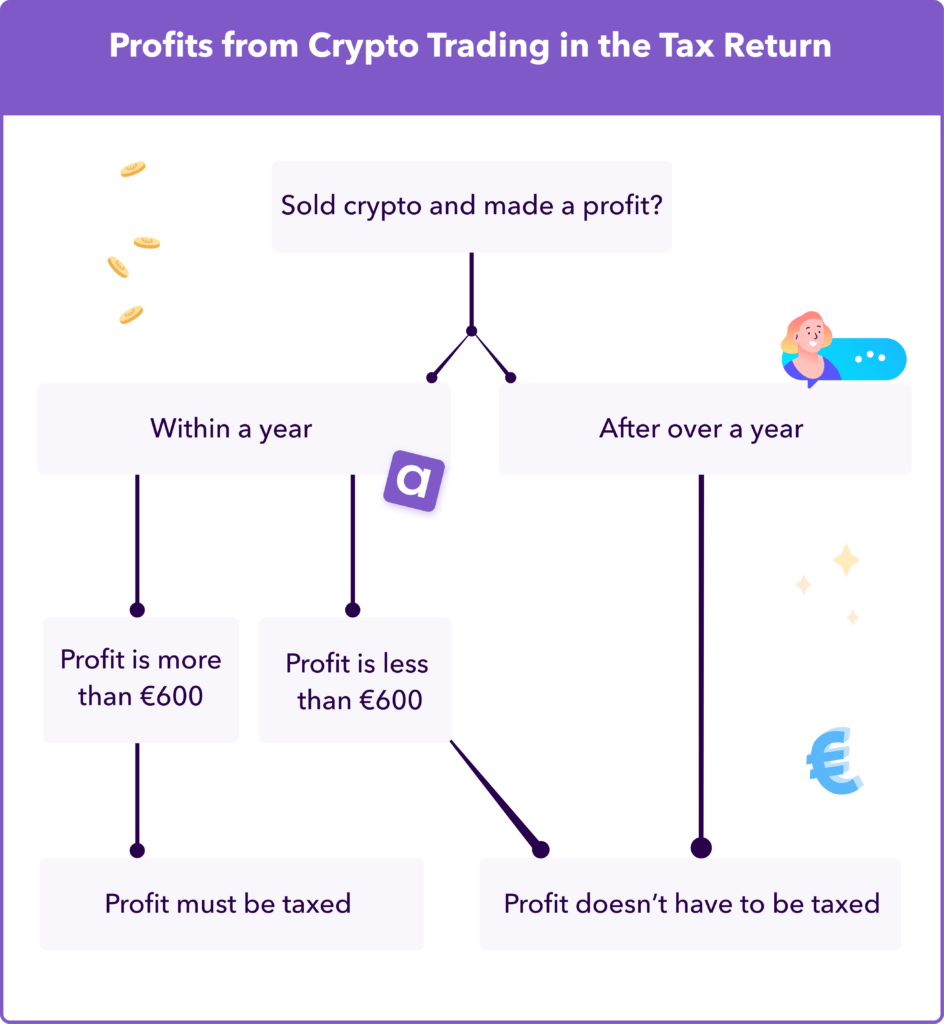
Are you trading cryptocurrencies as a private individual? If you buy digital currencies such as Bitcoin, Ethereum or Theter within a year and sell them again in the same year, it's possible that you have to pay tax on them. Because if you make a profit on the sale, you have to pay tax on it.
In this case profit is defined as the difference between the purchase price and the selling price. It is thus calculated by deducting your purchase price and any transaction fees from the selling price.
When selling crypto consider that if you want to sell your shares after a year has passed, you do not have to pay tax. So if you keep your cryptocurrency for longer than 12 months, there is no tax on your profit.
There is also the exemption limit of €600 (called Veräußerungsgewinn). If you earn less than €600 from the crypto sale, this remains tax-free. However, if your profit from the sale exceeds this limit, the entire amount will be taxable. So if your profit is €601, you have to pay tax on the entire profit and not just €1.
Also note that this €600 applies to all of your private sales transactions. So if, in addition to the sale of cryptocurrencies, you also have profits from the sale of gold or vintage cars, for example, the total profit from all sales must not exceed the €600 exemption limit.
How much tax on cryptocurrency?
If you sell your shares in a cryptocurrency, they are taxed at your individual income tax rate. Depending on how high your income is, you have a certain tax rate (between 14 and 42%). You have to apply this to your profits. So there is no fixed percentage that applies to everyone.
This is because cryptocurrencies do not fall under 'Kapitalvermögen' (capital assets), such as profits from shares and stocks. There is a fixed tax rate of 25% (plus solidarity surcharge and church tax) that applies to income from capital assets.
Instead, gains or losses from cryptocurrencies are assessed as 'private Veräußerungsgeschäfte' (private sales transactions). These are declared as other income in the Anlage SO (SO annex) in your income tax return.
Also note that as soon as you receive interest on the amount, this is always taxable. It doesn't matter whether you sell your cryptocurrency within a year or later. 'Abgeltungssteuer' (withholding tax) is always due on your interest gains.
There are good news, especially for the self-employed professionals... there is no VAT due on the trading of cryptocurrencies.
What is my income tax rate?
To know exactly how much tax you pay on your crypto trading profits, you need to know your tax rate. This is based on a percentage of your income.
It ranges from between 14% and the maximum tax rate of 42%. It is important to know that income tax relates to profits. So it is important to state all professional expenses fully and correctly in your profit & loss statement (Einnahmenüberschussrechnung) which is part of your income tax return. In this way, you can reduce your profit a little and may be subject to a lower tax rate.
What taxes are due on crypto losses?
If you sell your cryptocurrency at a loss, consider whether you have any gains from other 'privaten Veräußerungsgeschäften' (private sales transactions). You can offset these against it.
You carry out private sales transactions, for example, when you sell real estate that you do not use yourself. This also includes the sale of gold or bitcoins and other cryptocurrencies.
This also applies the other way around. So if you have losses from other sales, you can offset these against possible gains from the sale of crypto shares.
Report crypto profits in your tax return
Profits and losses from cryptocurrencies are entered in the income tax return in the Anlage SO (annex SO) for 'other income' in lines 41 to 46. Start with line 41 by entering the type of asset, i.e. what type of income you have. For example, in the case of crypto "Sale/trade in cryptocurrencies" could be noted here.
If you have regularly traded cryptocurrencies throughout the year, it is advisable to prepare another table with detailed evidence of the profits or losses. This way, you have proof should your Finanzamt inquire about it.
Trading crypto - commercially or privately?
If you do not trade in cryptocurrencies as a private individual, but do so as a professional business, different rules apply to you. This is because the profits are not tax-free after one year, but are always taxable.
As things stand, however, it is not yet clear when trading in cryptocurrencies is considered a commercial activity in Germany.
The good news is that even if you trade very often and have frequent reallocations, you are not directly considered a commercial crypto trader. This means that most people do not have to worry about the tax obligations of traders for the time being.
Tip from Accountable💡:It is important to be able to prove your profits to the Finanzamt and, if necessary, be able to verify that you have not made any taxable sales. So remember to always keep evidence and document your trading well.
The easiest way to do this is with a tax software like Accountable. This gives you full control of your bookkeeping and tax returns at all times. Find out more here!
Selbstständig starten, ohne Steuerfehler
Der komplette Leitfaden für die ersten 12 Monate - von Steuerberatern geprüft
Sophia has been a key member of the Accountable team for many years, bringing a unique blend of journalistic precision and in-depth tax expertise to her work.
They always answer right away to any question I have, they provide clear answers, and they are very patient even when I struggle to understand. They try to explain in different ways. They are very helpful, responsive and friendly.
Chiara Marradi
10/05/2026
This is an amazing application with great support on issues. In short as in day I am addicted to it (in a positive way). I myself is from IT project management and the way they have captured the user requirement, it’s phenomenal.
Sumit Tewary
01/12/2024
UI is great. Feature packed and very easy to use. The team at Accountable were VERY quick to respond and their team of technicians soon had a fix in place. Very happy with the level of service so far. Thumbs up from me!
Dean Osborne
05/06/2023
Everything was great! All my questions were answered quickly and in a friendly manner.
Wenzeslawa Wegener
11/05/2026
This program is a lifesaver, and it is always improving. Plus, it has an AI chat feature that is actually useful.
Jeffrey Humble
12/01/2026
The coaching session on tax management was excellent, good material, excellent explanations and very insightful. Combined with the AI I never feel alone with Accountable.
Sergio Barbarino
13/04/2026
The availability of your team to help and guide people to understand their finances better is what really makes Accountable valuable. While the AI is able to give answers to most basic questions, specific scenarios need counsel from a human which your team performs beautifully.
Norma
06/04/2026
Fast and careful answers from Alina. Top service. Thank you.
Anonymous
06/04/2026
In the world where everyone seems to be out to get small entrepreneurs and overwhelm them with new rules, more taxes and reporting obligations, Accountable often feels like the one steady partner that actually wants you to succeed, providing quick, clear and personalised support. Thank you!
Janina Arsenjeva
10/04/2026
They always answer for questions wherever is via direct e-mail or through app. If they can’t answer fully they will forward you to the right place. Documents were always prepared well and ready to send further to government. Everything is intuitive in the app and easy to sort out even for someone completely green in this field.








 10/05/2026

